
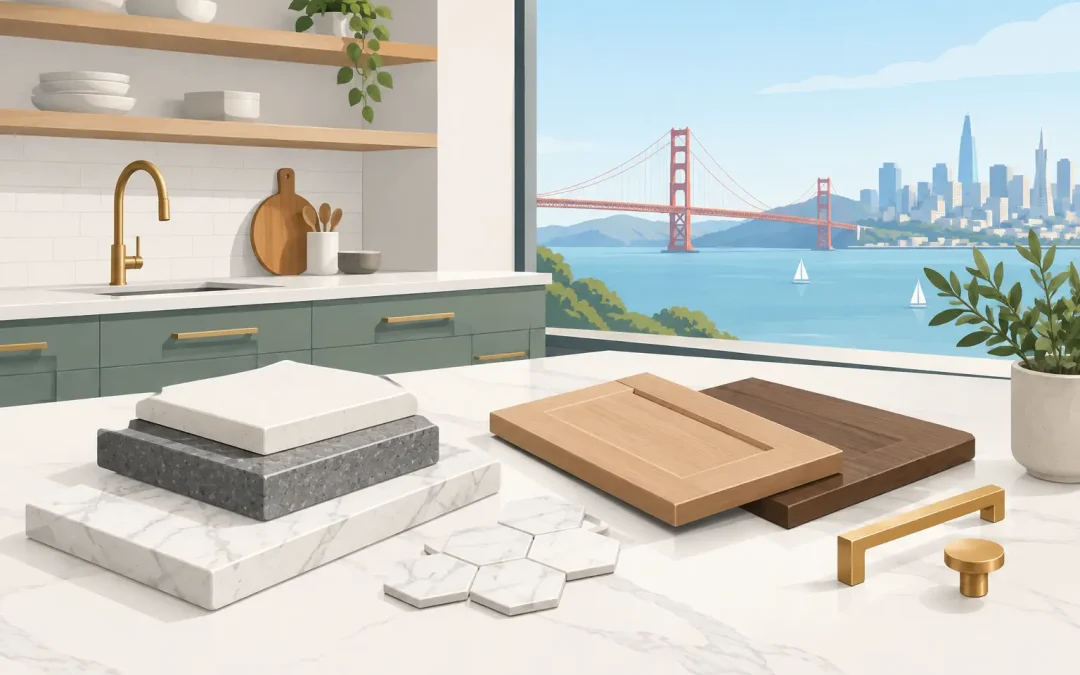
A kitchen can look exceptional on a design board and still disappoint six months after move-in. The difference often comes down to kitchen material selection: whether the countertop tolerates daily cooking, cabinet finishes hold up to children and pets, flooring feels right underfoot, and every surface works together under real Bay Area light.
For a full kitchen remodel, materials are not a finishing detail. They shape your budget, construction schedule, maintenance routine, and the long-term value of your home. The best choice is rarely the most expensive option in every category. It is the combination that fits how your household lives and gives the whole room a cohesive, well-built result.
Start Kitchen Material Selection With Daily Life
Before comparing samples, define what happens in your kitchen on an average week. A household that cooks every night needs a different setup than a homeowner creating a polished entertaining space for occasional use. A rental property, multigenerational home, and family kitchen each have their own durability and maintenance needs.
Think about heat, moisture, spills, traffic, and storage habits. Do you put hot pans directly on the counter? Are children likely to drag stools across the floor? Is the kitchen open to a living room where the cabinetry must read as furniture? These answers help narrow options early, before a beautiful but impractical finish finds its way into the plans.
Your home’s architecture matters too. A sleek flat-panel cabinet can suit a contemporary San Francisco renovation, while a painted shaker profile may feel more natural in a Berkeley bungalow or traditional East Bay home. The goal is not to follow a trend blindly. It is to make the new kitchen feel intentional within the rest of the property.
Choose Countertops for Performance First
Countertops carry much of the visual weight in a kitchen, but they also take the most direct abuse. Material selection should balance appearance with your tolerance for maintenance.
Quartz remains a practical choice for many Bay Area homeowners. It offers consistent color and pattern, resists stains well, and does not require routine sealing. It is especially useful for busy kitchens where easy cleanup is a priority. However, quartz is not indestructible. Extreme heat can damage the resin binders, so trivets still matter.
Natural stone such as marble, quartzite, granite, or soapstone brings depth and variation that engineered materials cannot fully replicate. Granite and quartzite generally perform well in hardworking kitchens, though each slab should be evaluated for its particular porosity and finish. Marble offers a classic, high-end look but can etch and stain. For some homeowners, that evolving patina is part of its appeal. For others, it becomes an ongoing frustration.
Porcelain slabs are increasingly popular for contemporary kitchens because they can offer dramatic stone-like looks with excellent heat and scratch resistance. They can be a strong option for countertops, backsplashes, and waterfall islands. Their fabrication and installation require experienced handling, so the project team should account for that early.
The edge profile and slab layout deserve as much attention as the material itself. A simple eased edge can look clean and timeless, while a mitered edge creates a thicker, more substantial appearance. Vein direction, seams, and the relationship between the island and perimeter counters should be resolved before fabrication begins.
Cabinet Materials Set the Kitchen’s Foundation
Cabinets represent a major share of a kitchen remodel budget and have a major impact on function. Door style gets attention, but cabinet construction, finish quality, and hardware are what homeowners live with every day.
Painted wood cabinets offer a tailored, custom appearance and work across many design styles. They can be refinished or touched up, but expansion and contraction at joints may eventually show through painted finishes. This is normal for wood products, particularly in areas with changing temperature and humidity.
Wood veneer cabinets provide natural grain with a more modern, controlled profile. They are well suited to walnut, oak, and rift-cut white oak designs, where the grain itself is the focal point. Veneer quality varies, so details such as edge banding, grain matching, and panel orientation should be part of the design conversation.
Thermofoil and laminate can be cost-conscious choices with broad color options and straightforward cleaning. They may be appropriate in a secondary kitchen, rental unit, or project where the budget needs to be directed toward layout changes and structural work. In a high-use primary kitchen, higher-quality cabinetry often delivers better long-term value through stronger boxes, durable finishes, and hardware that stays properly aligned.
Inside the cabinets, prioritize full-extension drawers, soft-close slides, adjustable shelving, and storage that fits your routines. Deep drawers for pots, pullout waste bins, tray dividers, and a purposeful pantry can improve a kitchen more than an elaborate door profile ever will.
Flooring Must Connect the Whole Home
Kitchen flooring needs to handle dropped utensils, splashes, and daily foot traffic while connecting visually to adjacent spaces. This decision is particularly important in open-plan remodels, where the kitchen floor may extend through the main living area.
Porcelain tile is highly durable and offers a wide range of stone, concrete, and wood looks. It is a dependable choice for moisture resistance, but grout maintenance and a harder feel underfoot are worth considering. Larger-format tile can reduce grout lines and create a cleaner appearance, provided the subfloor is prepared correctly.
Hardwood flooring creates warmth and continuity, especially when it runs from the kitchen into dining and living areas. Engineered hardwood can be a practical option over concrete slabs or where greater dimensional stability is needed. Wood will show wear over time, but many homeowners prefer that lived-in character to a floor that looks artificial.
Luxury vinyl plank can provide water resistance and a lower upfront cost, though its appearance and lifespan vary considerably by product quality. It may make sense for an ADU, investment property, or a project with strict budget limits. For a high-value whole-home remodel, homeowners often choose materials with longer service lives and a more substantial feel.
Whatever flooring you select, transitions, floor height, and appliance clearances must be coordinated with the construction plans. This is one of those small details that can create avoidable problems if material choices are finalized too late.
Use Backsplashes and Fixtures to Add Character
The backsplash is a good place to introduce texture, color, or movement without overwhelming the room. A full-height slab backsplash creates a clean, luxurious effect and simplifies cleaning. Tile can offer more personality, from handcrafted ceramic to classic subway tile or bold geometric patterns.
If the countertop already has strong veining, a quieter backsplash often produces the better result. If the counters are calm, tile may become the focal point. The same principle applies to cabinet hardware, faucets, and lighting: choose a clear hierarchy rather than asking every finish to make a statement.
Mixed metals can work beautifully when they are deliberate. For example, warm brass cabinet hardware can pair with a matte black faucet if each finish is repeated elsewhere in the room. Limiting the palette prevents the kitchen from feeling assembled piece by piece.
Budget for the Materials You Touch Most
A balanced budget does not mean spending equally across every category. It means putting money where performance and craftsmanship will be felt over time. Cabinet construction, countertop fabrication, plumbing fixtures, and installation quality usually deserve priority over short-lived trend features.
Be realistic about lead times. Custom cabinets, specialty tile, natural stone slabs, and certain appliances may require decisions well before construction starts. Changing materials after orders are placed can affect cost, permitting coordination, and the project schedule.
At Good Vibes Design & Build, we help homeowners review material choices alongside the full scope of work, from plans and permits through construction and final walkthrough. That coordination helps prevent a common problem: choosing finishes independently, then discovering they conflict with the budget, existing conditions, or installation requirements.
A Better Way to Compare Samples
Do not judge materials under showroom lighting alone. Bring samples home when possible and view them in morning, afternoon, and evening light. Place cabinet colors beside flooring, countertop samples, wall paint, and hardware. A white that appears crisp in a showroom may read yellow or gray in your actual kitchen.
Ask practical questions as you compare options. How will this surface age? Can it be repaired? Does it require sealing? Will its pattern hide or highlight daily messes? Is the material readily available if a future repair is needed? A finish that looks perfect in a small sample may feel too busy across a large island or full-height wall.
The right kitchen should support ordinary life while still feeling like a transformation every time you walk in. Start with the way your home is used, make a few purposeful material investments, and let an experienced design-build team manage the details that turn those selections into a kitchen built to last.